The Minister of Transport inspects the work sites on the first line of the high-speed rail network 26/07/2026 | 11:48 AM
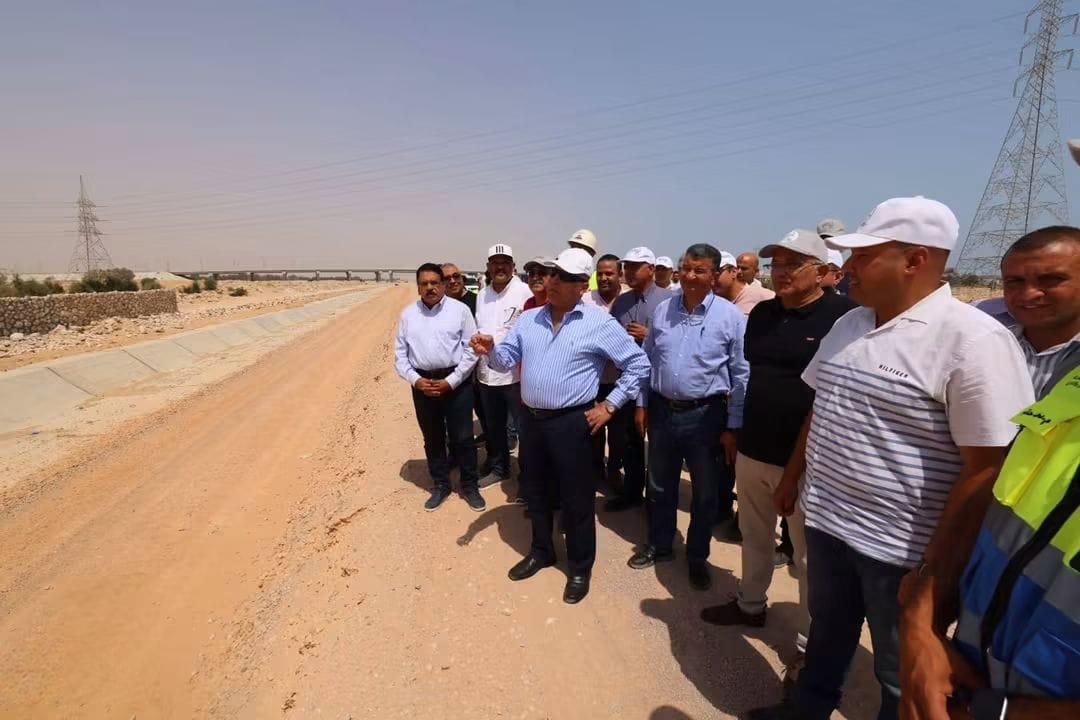
The Minister of Transport inspects work sites on the first line of the electric train network, from Marsa Matrouh to Nubaria.
In line with the directives of His Excellency President Abdel Fattah El-Sisi to continuously monitor the high-speed electric train network project, Lieutenant General Engineer Kamel El-Wazir, Minister of Transport, inspected the work sites on the first line of the high-speed electric train network, the Ain Sokhna/El Alamein/Marsa Matrouh line, which is 660 km long and falls within the Ain Sokhna/Dekheila logistics corridor, specifically the section from Marsa Matrouh to Nubaria. He was accompanied by Major General Hossam Mostafa, Assistant Minister for Roads and Bridges; Major General Tarek Gweily, Chairman of the National Authority for Tunnels; Major General Mohamed Hassan, Chairman of the General Authority for Roads and Bridges; Engineer Ibrahim Bakheet, Vice Chairman of the National Authority for Tunnels; and leaders from both authorities and the heads of the companies implementing the project.
The Minister inspected the construction sites along the stretch from Marsa Matrouh station to Nubaria station, passing through the stations of Ras El Hekma, El Dabaa, Sidi Abdel Rahman, El Alamein, El Hammam, Borg El Arab, the Army Stadium (King Mariout), and Nubaria. This inspection aimed to monitor the progress of the construction and finishing work at these stations, which will contribute to revitalizing and supporting tourism. These stations are located on the high-speed rail line along the international coastal road and are situated in the heart of these cities, serving residents, workers, and visitors. The high-speed rail service is expected to be a positive incentive for people to move to these areas for work, tourism, residence, or to establish investment projects that require a workforce and a safe and modern means of transportation offering the highest levels of service to passengers. The Minister reviewed the finishing work at the stations, the passenger flow plan from the main entrance of each station to the ticket halls and platforms, the availability of elevators to facilitate passenger movement, and the plan for optimal administrative and investment utilization of all spaces within the various stations.
The Minister also monitored the progress of several engineering projects along this stretch, including bridges and tunnels. The Minister inspected the completed sections and the ongoing work, including the culverts and canals, and directed that the work be carried out according to high-quality standards and around the clock to complete the project on schedule.
He also directed the construction of pedestrian bridges alongside the road bridges that intersect with the high-speed electric train line to facilitate the movement of citizens in the areas along the train's route, maintain the track's right-of-way, and complete approach roads to connect stations to main roads. The Minister also followed up on the completion of bridge works for the entire route, as well as the laying of basalt and sleepers and the track work. He directed the completion of paving the service roads parallel to the track, given that internal service roads are used for laying basalt and installing sleepers and rails, while external service roads are used to serve residential areas and agricultural regions. During his tour, the Minister emphasized that the implementation of the high-speed electric train network represents a great epic being carried out on Egyptian soil, as it will connect all parts of the country. He added that with the completion of the first line of this network, the connection between the Red Sea and the Mediterranean will be achieved by land, creating a new Suez Canal on rails. The Minister thanked all those working on the project for their efforts in implementing this monumental project. He pointed out that the high-speed electric train represents a tremendous leap forward in sustainable, environmentally friendly green mass transit, providing a safe, fast, and eco-friendly means of transportation that contributes to reducing reliance on traditional transport, lowering fuel consumption and carbon emissions, and supporting the state's drive towards green transformation and commitment to the Sustainable Development Goals, in line with the National Climate Strategy and Egypt's Vision 2030. He noted that the importance of this project is not limited to the transportation sector alone, but extends to include comprehensive economic and developmental dimensions, as it contributes to: supporting industrial development by improving the efficiency of supply and transport chains; attracting local and foreign investments; creating direct and indirect job opportunities; supporting urban development and connecting new areas with existing cities; and enhancing Egypt's position as a regional hub for transport, logistics, and transit. It is worth mentioning that the high-speed electric train network currently under construction consists of three lines with a total length of 2,000 km. The first line (Sokhna – El Alamein – Marsa Matrouh) is 660 km long and includes 21 stations and a control center. It also includes 15 high-speed trains and 34 trains. A regional train and 14 freight locomotives